
Henry Olsen '83 on the 2026 Midterms, Populism, and the Judeo-Christian Moral Tradition
The Forum sits down with Washington Post columnist and CMC alumnus Henry Olsen.
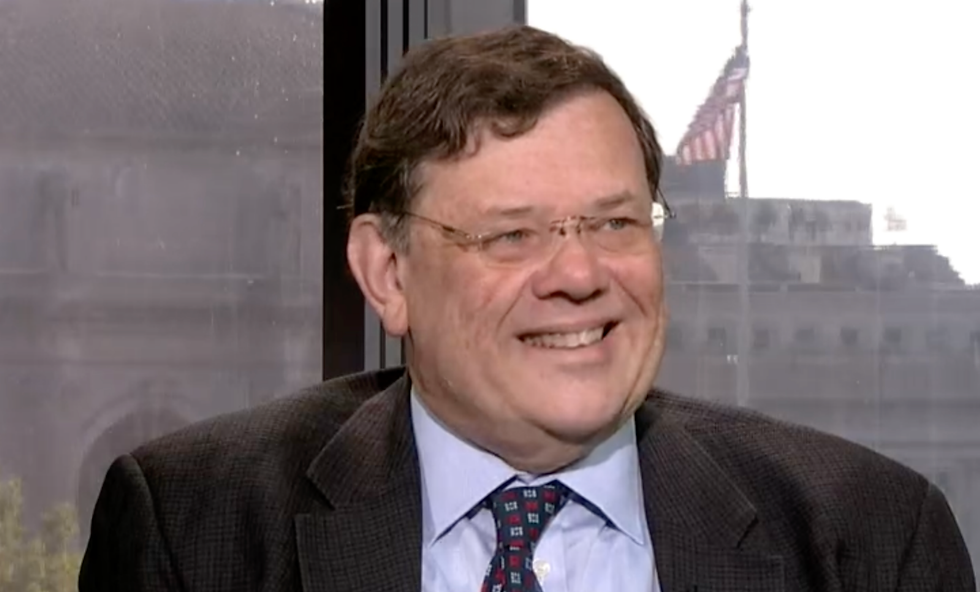
Shiv Parihar: Hello, I'm Shiv Parihar.
Sarah McPeek: I'm Sarah McPeek.
Shiv Parihar: And you're here with The Forum, sponsored by the Salvatori Center. We're honored today to be joined by Henry Olsen, a senior fellow at the Ethics and Public Policy Center, and a columnist for The Washington Post.
Henry Olsen: Thank you all for having me here, particularly with Mr. Salvatori, who was absolutely instrumental in the election and the recruitment of Ronald Reagan in 1964 through 1966, that helped launch his career and hence save America.
Sarah McPeek: Your election forecasts have been unusually accurate. What is one indicator that you trust that others seem to undervalue?
Henry Olsen: I ask the questions that most people don't. I try to ask the question: How could things be different? And I rely not on looking at aggregate patterns, but at granular patterns. So I predicted that Romney would lose rather comfortably when every other Republican analyst said he was going to win comfortably, and that was based on a granular assessment of polling data. I predicted that Trump was not going to lose the popular vote by three to six percent when everybody else was saying he would in 2016. I said he would at best lose by a point or two, and that meant he had a very good chance to win the election. Same thing in 2024, I look very carefully at data, and I try to ask the question: What is different here? What would have to be different? That usually lets me see things that more mainstream analysts or media types miss.
Shiv Parihar: One of your areas of expertise has been populist movements across the world. How do you define populism, and what do you think Americans are missing in our understanding of it?
Henry Olsen: I wrote a quasi-academic piece defining populism back in 2010 or 2011 as an attitude that had four attributes. It defines itself as being with the mass of the people who have been unjustly deprived of something that is their due as citizens by a definable elite, that the restoration of rule by the just people and the unseating of the unjust elite will redress that balance, and that the unjust elite are treated as adversaries rather than enemies. What you've been seeing essentially is the rise of both left and right populism. Occasionally, you'll see center populism, but that usually fades pretty quickly. [Left and right populism] differ in their definition of what is just, what has been deprived, and who is doing the depriving. So, if you look at left populists around the world, they tend to ascribe the ill as being a deprivation of material equality, and the unjust elite as being billionaires, multinational corporations, globalist trading systems. On the right you tend to see the argument being that they have been unjustly deprived of their worth as citizens, which includes a cultural dynamic as well as an economic dynamic, that it is a cabal of elites, academic, media, and economic that combine to take a set of viewpoints across the span of issues.
Most Americans don't know what's going on elsewhere: They tend to say what is going on in America is unique to America. It's not. It's going on throughout the developed world. What you need to do is put yourself in the perspective and ask why are the same types of people in 50 different countries that hold regularly scheduled elections acting in the same way, and when you ask that question, you see things much differently than if you ask the country-specific question or the personality-specific question.
You've got the question: Is there Trumpism after Trump? And I say, of course there is. The only reason Trump won was not because of Trump. It's because he identified himself with pre-existing positions. I always point to a 2010 poll that showed that the group of people who largely were blue-collar whites didn't like wars in Afghanistan, thought that trade was bad for America, and didn't like immigration, and supported social welfare policies like Social Security and Medicare. What did Donald Trump say when he came down the escalator? If Donald Trump had come down and said, “I'm a billionaire, and I think the problem is we didn't move too much in favor of neoliberal economics,” he would have gone nowhere. He combined his personality with a preset of issues that represented a worldview that people already have. So of course, there's going to be Trumpism after Trump. There was Trumpism before Trump.
Sarah McPeek: What else do you think American politicians and American voters are — or aren't — learning when they look at populism abroad?
Henry Olsen: They're not learning the right things in general. American voters on the left or right tend to view the European populists through their own lens. On the left, they'll say, “they're all neo-fascists who want to destroy democracy,” which is not true. On the right they tend to say “they don't like immigration and they support Christian culture, therefore they're just like us,” and they overlook the fact that many of them actually don't like the United States very much. The AfD in Germany, for example, is very pro Russia, and would prefer to actually withdraw Germany from NATO. So they see what they want to see, and they don't look deeply enough.
That's at the voter level, and at the elite level, I would say there's still some of that same myopia that elites on the left and elites on the right see, similarly to their voter bases. What they also have is a sense that the elites tend to be distinctly anti-populist, both right and left, because they are the ones who have benefited from the global order that was constructed after 1989. I wrote an article for Unherd in 2017, saying it's not left versus right, it's ins versus outs.
Most elites are, whether they're left or right, in the 'ins.' So they look at populism as something that is still temporary, that is controllable, that is reversible. It is not controllable; it is reversible only by adopting the policy prescriptions that the populists support, because there are actually legitimate reasons for them to hold their viewpoints. The consensus that was promised after 1989, particularly after the Chinese entered the WTO in 2001 and the unipolar moment of American global supremacy, did not produce peace in the globe, did not produce prosperity for all in the developed world, and did not produce a lessening of social tensions at home. And in fact, it presided over an increase in global instability and hostility and an increase of social tensions at home. The elites will continue to not understand populism until they are displaced by the populists.
Shiv Parihar: Sarah asked about Europe's populist movements. Brazil has an election in just a few weeks, and up until now, Donald Trump has a 100 percent record of endorsing candidates in Latin America since he's been elected to his second term, and having them win their elections, usually populist right-wing candidates aligned with him. You wrote about the last Brazilian election. Do you have any thoughts on the relationship between American populism and the populace to the south of us, especially how it might connect with Hispanic voters, oftentimes, the most in contestation group in America?
Henry Olsen: The thing that's driving populism in Latin America is related to, but not identical to, the things that are [driving populism in the United States]. The consensus is a problem down there, like with Argentina. Argentina has been ruled by a left populist movement for most of the last 80 years. Peronism and the right populism there essentially would like Argentina to join some form of neoliberalism because it would benefit a low income country like Argentina. In Chile, populism is largely driven over cultural concerns. We get a lot of the immigrants from Colombia and particularly Venezuela, but they get them there too, and so you've got the concern about illegal immigration and cultural issues driving people to the more extreme right. Of course, in Colombia, you have the ongoing question of genuine narco-terrorism that has bedeviled that country for decades and has not been put to rest, and certainly was not put to rest under the country's first genuine left populist president.
But of course there is also a cultural sense that Brazil, in particular, has a strong Protestant population. A biblical Protestant worldview sees itself as threatened [in the United States] and in Costa Rica, where there's also a large number of biblical Protestants who are actively involved in politics. Of course, you saw a right-wing populist decisively win the Costa Rican elections earlier this year. So that adds a more American-esque element to it.
Shiv Parihar: You oppose attempts to ban populist insurgent parties like the AfD, which have been discussed, you know, particularly the German left. Can you tell us about why you think that doesn't work?
Henry Olsen: It doesn't work because of voters. You can ban an entity, but you can't ban a voter. You can only ban a voter by banning their viewpoints, and you can only ban their viewpoints by eliminating free speech and imprisoning people who violate that. Even Germany, if they want to ban the AfD, are not going to do that. So what they'll simply do is find a new vehicle. The example I like to give is in Belgium. In 2004, there was a group called the Vlaams Blok, an ultranationalist Flemish right populist party. It was accused of racism, and the government was about to shut it down for some violation of campaign finance rules or something. They decided to shut down the Vlaams Blok, and they started a new group called Vlaams Belong, and Vlaams Belong is now one of the strongest parties in Flanders. The only way to stop the viewpoints of voters is to imprison or kill their leaders and make it illegal to express their viewpoints. In other words, what Putin does, and I don't think Germany is going to be there.
Sarah McPeek: Moving back to America and onto the midterms. You've recently described a lack of unity among Republicans following primaries. I'm wondering why, when you've seen such contentious Democratic primaries — thinking about Michigan and Maine — Democrats have united in a way that Republicans have failed to.
Henry Olsen: They've united because they hate Donald Trump. There will be people who will battle in 2028 for the future of their party. But when it comes to defeating a candidate of the Republican Party that will largely support Donald Trump, they are united in that, and so they're overlooking the differences in the sake of beating a common enemy. Of course, once you no longer have that common enemy, then these differences matter again, and you will see a very very difficult fight between a center to center left establishment and a left of center to far left insurgent populist wing, one that's not capable of being predicted this far out. One can easily see it arising simply because we've been seeing it arise in primaries throughout the year, and we've seen both sides have their share of victories.
Shiv Parihar: Turning to a more theoretical question, you're a senior fellow at the Ethics and Public Policy Center, which focuses on the Judeo-Christian moral tradition. I'm curious where you see the boundaries of that tradition lying within American civic life and how you see the growing demographics of, say, American atheists, or as they usually are in surveys, nones, or even Muslims or Buddhists, as fitting in.
Henry Olsen: When I talk to my colleagues at Ethics and Public Policy Center from a political standpoint, I say that the thing you have to understand is that the median American voter is a Christian who never attends services. So, from a political standpoint, any sort of attempt to apply a broad Judeo-Christian ethic has to appeal to that voter. That voter is often not attending services because they disagree with more traditional aspects of the Judeo-Christian practiced religions, and so consequently are not amenable to being appealed to on the very grounds that would activate people who are most attached to the propagation and installment of a Judeo-Christian worldview — abortion is a perfect example of that. There are people who attend Jewish services or Christian services who are strongly anti-abortion. There are many people who attend who are strongly pro-abortion, but there are even more who are in the non-attending group that support abortion rights. You have to be very careful in the modern political world to decide what are the aspects of a traditional Judeo-Christian worldview that are politically possible at this moment. I think what you have to understand in America is that modern America remains more traditionally religious than most Western democracies, but it remains and is becoming much less traditionally religious than it has ever been before.
If you want a return to tradition, that's not a political battle. That's a battle to be fought by talking on the campuses. You should be going to people who say they're Christian but don't attend church anymore and ask why don't you come back. When I was young, close to 50% of Americans were attending services at least on a monthly basis, Jewish or Christian services. There were virtually no non-Christian religions of note. This was the world Ronald Reagan was elected in.
You can't ever look and say that there was an American political leader that said, “give up your religious beliefs, stop going to church, it's all a lie.” This is stuff that was happening in the culture, and so people gradually decided they didn't believe anymore. The 'nones' are very different, according to Ryan Burge, an interesting political scientist who writes on religion. They may not be Christian, but some of them actually go to church. Many of them pray and believe in a higher power, but they don't adhere to the traditional Christian church hierarchy or organization, so they're between the atheists and the agnostics and people who still declare themselves to be Christian. But, you probably now have six to ten percent of religious people who are not Judeo-Christian in there.
That gets to the last thing that I emphasize to my colleagues, which is that there are similarities in worldview across these religions, particularly with respect to things like the nuclear family, as being a primary order or organizing force of society. In a political sense, what you have to do is appeal to that, as opposed to a theological underpinning of that. I cannot speak for any of my colleagues at the Ethics and Public Policy Center, but you are owed an honest answer from me as to what I do, and you have received.
Shiv Parihar: How do you see this changing coalition form? There was a Sikh prayer at the Republican National Convention, James Talarico is sort of bringing a new Christian-left thing, Vivek Ramaswamy has tried to appeal to evangelical voters — do you think this could have any impact at all, or do you think it's mostly just fluff?
Henry Olsen: Look, there's always been a Christian-left, James Talarico, and an evangelical left. Even today, probably one-sixth to one-fifth of regular church-going evangelicals vote Democratic, and these are people who interpret the evangelical tradition in a way that is more consistent with a center left to left wing viewpoint. As they might say, they're ‘Matthew 5’ Christians, people who focus on the beatitudes rather than other aspects of theology. “Blessed are the poor” is more important to them than other aspects. That's a perfectly legitimate way to interpret Scripture.
What is happening is the American political system is dealing with not just sect diversity, which has been present in America from its founding: you're now dealing with the question of a large electorally significant group of non-Jewish Christian religious diversity. I think the American political system is trying to determine through its actions where this fits, and different people will try different things. I think that the American political tradition will find a way to speak to people of varying religious traditions in a way that brings them into the American mainstream. And there'll probably be many ways to do that. Vivek's is one, and J.D. and Usha Vance's is another. Nikki Haley chose another path, as somebody who was raised as a Sikh who named her children after Sikh names, but converted to being a Christian herself. There are going to be many different paths in trying to do this, but as long as we have freedom of religion, I see no way that that is in any way restricted in a way that would be impactful for non-Christian religious minorities. They will be brought into the American cultural and political mainstream. Catholicism was once thought to be inconsistent with American democracy: It no longer is. We have a way of bringing people outside of once dominant faith traditions into an American civic political tradition, and I have no doubt that we will do so with non-Christians as they become more numerous among the American citizenship class.
Sarah McPeek: You wrote about factions in the Republican Party. Looking three years into the future post-Trump, what do you see as being the factions in the Republican Party?
Henry Olsen: Factions change over time in determination and in reaction to political questions of the day, but I think we can safely say that things don't change so dramatically absent a massive intervening event. You have economic populists, people whose primary concern is: “You've closed my factory down, what are you going to do about my community, what are you going to do about my standard of living.” These people are people who are economically out of sync with the post-1989, post-2001 neoliberal internationalist group.
You have religious conservatives who have always been a part of the modern Republican Party, and they are concerned with things like religious liberty, traditional sexual archeology: “Biological women are biological women, and biological men are biological men.” Abortion is less important to this group than it was 20 years ago.
You have kind of a nationalist wing, which sees it around an assertion of American patriotism, hard line on immigration, and a restrictionist view on foreign policy. These are the people who really don't want America involved in the Middle East. They're not a majority of this faction, but they are part of this faction.
Then you have the non-MAGA Republicans, and those consist of a small number. It used to be that 20 to 25 percent of primary voters in the Republican Party would say they're moderate — most of those have left the Republican Party, but some are still there, you have five to 10 percent who are still moderate. They don't like any form of conservatism, but they really don't like the liberalism that they see in the Democratic Party, so they remain dissatisfied Republicans.
There's one other group that has aligned with MAGA, and that is people who prioritize tax cuts. The people who prioritize tax cuts are with the Trump administration and with MAGA because they continue to prioritize tax cuts. The ones who prioritize spending cuts, like former Vice President Pence, are dissatisfied. They are part of what I now call the old guard. The old guard is essentially the people who [want to] go back to the arguments we had before Donald Trump within the Republican Party. I wrote a whole book about those arguments, called the Four Faces of the Republican Party.
But, there’s no reason to think that in the next three years that there will be an event that forces people to redefine themselves, or that any MAGA-oriented presidential candidate will so define themselves in a way as to alienate part of the four-part MAGA coalition.
Shiv Parihar: Thank you, Mr. Olsen, for joining The Forum!


