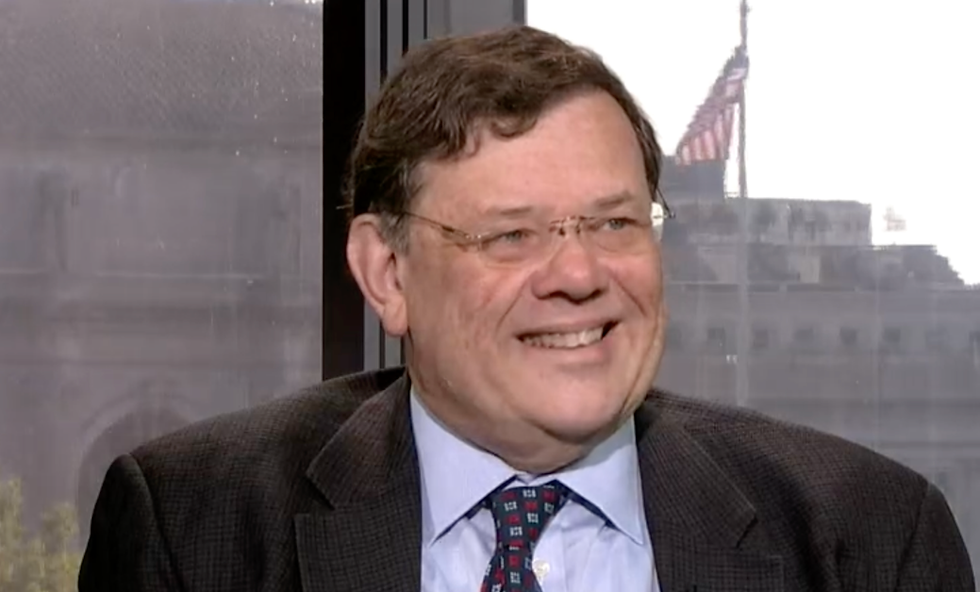
Steven Teles on the Abundance Agenda
Steven Teles is a Professor of Political Science at Johns Hopkins University and a Senior Fellow at the Niskanen Center. Teles sits down with Dhriti Jagadish '27 and Shiv Parihar '28 to talk about the Abundance Agenda.
This interview transcript and recording have been edited for length and clarity.

Shiv Parihar: Hello and welcome to The Forum Podcast.
Dhriti Jagadish: I'm Dhriti Jagadish.
Shiv Parihar: I'm Shiv Parihar.
Dhriti Jagadish: And today we're with Steve Teles. Teles is a Professor of Political Science at Johns Hopkins University and Senior Fellow at the Niskanen Center. He is an influential scholar of American political institutions, known for his work on polarization, state capacity, and the structural incentives that shape politics. He’s the author of The Captured Economy: How The Powerful Enrich Themselves, Slow Down Growth, and Increase Inequality; The Rise of the Conservative Legal Movement: The Battle for Control of the Law; and Whose Welfare: AFDC and Elite Politics. He has been published widely in Democracy Journal, The Nation, National Affairs, and National Review.
Dhriti Jagadish: Welcome Steve Teles to The Forum.
Steve Teles: Thanks for having me.
Dhriti Jagadish: So first question. It’s December 2025. It's been a big year for the Abundance movement—support, as well as criticism. To start, can you define the Abundance Agenda for our audience?
Steve Teles: I'll try and give you the simplest version, which is that everybody who's in some ways in Abundance—the thing that everybody has in common is a belief that we need to solve a lot more of our problems through supply. Many of these problems are not fundamentally redistributive. They're about the fact that there's not enough housing, not enough infrastructure, not enough healthcare.
And you can go through the causes of that. And one thing that causes people [in the movement] to vary is, “What are the causes of our supply problems?” But everybody in Abundance believes that there's some fundamental supply problem at the root of all of our policy, economic, and other problems.
Dhriti Jagadish: We want to talk about some critiques of Abundance. From the left, some say the Abundance Agenda is too critical of progressives when it's corporations that are monopolizing the market, for instance. On the economic right, some critics have said that Abundance is not at all pro-free-market, making individual problems and productivity everyone's business. What criticisms are the most sound, and how do you respond to them?
Steve Teles: So most of them are not sound, because Abundance is awesome—I'll start out with that answer. The first thing I would say is that it's certainly entirely possible to be progressive or left or socialist and be Abundance. And so in this “Varieties of Abundance” paper, I have this category that I call “Red Plenty.” And the graphics in that are sort of consciously, sort of playing with Socialist Realism, right?
But Zohran Mamdani has explicitly tried to gesture toward Abundance. He said that he wants to build a lot more housing. He wants to get rid of a lot of constraints on small business and the rules and regulations that they have to face. If you want to build a lot more things in the public sector, if you want to pull a lot more things into the public sector, the only way to really do that is to make those things more affordable. Because if those things are really expensive, then the amount of stuff that you can actually get into the public sector is going to be a lot lower.
And so the example I always used is single-payer health care, right? If you pull all the costs in the healthcare system into the public sector, then all of the problems are how much we pay doctors. And the fact that it's really hard for doctors from India or Nigeria or all over the rest of the world to come to the United States. Lots of times, workers face competition from international immigration, which I think is actually good. But it actually turns out [in] health care, we have an incredible system of protectionism. The fact that you're doing something in the public sector doesn't mean that you wish away all those problems. In fact, those problems are even more severe.
So I actually think Abundance is kind of sideways to our normal left-right spectrum. Those are problems that people across the spectrum have to face. So I give the example of what I call “Cascadian Abundance,” which is the [variety of Abundance] that's most aligned with environmentalism. If you want a really fast transition to a low-carbon future, you're going to have to build a gargantuan amount of clean energy—way more than anyone’s figured out how to site, and permit, and transmit, and everything else. And if you're going to do that without immiserating people, you're going to have to figure out how to solve all of the problems of proceduralism, and rules, and regulation—including regulation of the public sector.
So I actually think, in some ways, I'm not sure why we're having this weird Progressive vs. Abundance argument. Because again, I think Abundance is something that cuts right through the left-right spectrum, rather than something that rests on the left-right spectrum.
Shiv Parihar: Before I jump to the next question, I wanted to ask you about something you said. You said you thought it was a good thing that workers would have global competition as opposed to just sort of local competition. I wanted to ask if you could elaborate and say why that's your stance.
Steve Teles: So one is, it's certainly good for the people who are competing, right? That is, one of the reasons why we've had a historically extraordinary drop in poverty is precisely [because of] international competition. And, to some degree, also immigration, but that's another story, because actually remittances, from people who immigrate, are a very important part of the economy of lots of developing countries, and that actually ends up feeding into lots of good things for [their] development.
The basic story is: every developed country gets wealthier by gradually moving people up out of things that are less technologically sophisticated, that have less embedded human capital—into things that have more. And those things then drop down to people who have less human capital—who are in less developed countries.
Again, none of this is genius level economics. The thing that makes entire countries wealthier, it means those are the things where there's actually more demand to pay higher wages for, especially for in person services, right? People transition from being in manufacturing into services, paying for people who've got higher value-added things they're doing, and that process is basically good. So long as you make sure that lots of people can participate in it.
Shiv Parihar: Interesting. Well, another critique often leveled at the Abundance Agenda—both from people on the left and the right that care about issues like LGBT rights, abortion, guns—is that the Abundance Movement completely sidesteps some of the social issues which are at the core of fundamental moral debates in American politics. What's your response to those critiques?
Steve Teles: I think that's also a weird critique, right? That's like a critique of saying you're not talking about the thing I'm interested in. Now, part of it is, a lot of those problems are irreconcilable. No one's learning anything new. I mean, gun control is a little more complicated: I think we are actually learning some things about what can reduce gun crime. But those are issues that people who’ve got fairly idiosyncratic moral positions really want to be talking about. I always say that one way to think about our politics for the last 30 years is [that] it's been hijacked by people who are pretty extreme—who really want to argue about the thing that they disagree about.
There's lots of people who care about other stuff, the things that actually really matter to people on a day-to-day basis. Do they have a house? Do they have schools that work? Do they have police that are actually effective and keep them safe and don’t end up beating up their cousin, right? Those are the things that most people care about. And, it’s not like the things you mention don’t matter.
But, we depend on government to do a lot of really basic stuff, right? It has to repair roads, and pick up trash, and educate kids, and do all those other things.
But it feels like whether or not people's politics are solving those problems have gotten sidelined. And a lot of what Abundance is about is saying “Let’s put those things at the center of our politics.” And those are things that we actually could do a lot better at, that actually would make a lot of difference in ordinary people’s lives. And so in some ways I think Abundance is actually centering things that ordinary, working-class people care about more than the politics that are really developed around people who’ve got very strong moral politics—not that that's not important. But [it] doesn't have to monopolize what we're doing in politics.
Dhriti Jagadish: The Revolving Door Project has termed Abundance as a neoliberal rebrand, but you've argued that Abundance has roots in the Progressive movement of the early 20th-century. Can you explain this historical analogue and how the Abundance movement represents both continuities and departures from the Progressive movement? Why does it or why doesn’t it have similarities to the neoliberalism of the ‘70s and ‘80s?
Steve Teles: Well, let me go back to the Progressive analogy, because you can do this either well or badly. It's not really the purpose [of the analogy] to say “the Progressives were great and all their reforms were fantastic.” California is living through some of the worst of its reforms, like referendum [and] initiative. In California, that's a disaster—I think most people who studied this think [it] has been a disaster.
But the thing that's really interesting about the Progressives and why I think it's a good analogy, is they were trying to get the political system to talk about something different than the thing that had dominated the political spectrum. You go back to the late 19th-century. What is everybody arguing about? They're arguing about tariffs. They're arguing about the gold standard. To some degree, they're still arguing about who did what in the Civil War—what people used to call “waving the bloody shirt.” That's what politics was, and Progressives were, in part, saying, “You know, we ought to be arguing about something else.” So it's not a surprise that the Progressives were in both the Democratic and Republican Party right. Woodrow Wilson was a Progressive on the Democratic side. Teddy Roosevelt was a Progressive [on the Republican side].
The core of Progressiv[ism] was really about cities. You think about Chicago, right? Unbelievable. You know, productivity that suddenly happen[s] because we get refrigerated rail cars: the fact we've got rail all over is suddenly massively reducing transaction costs in the economy. It's creating enormous productivity, right? And we've got these cities that are being run by these patronage machines that are not really organized to produce public value. They're organized to produce, as they used to say, “jobs for the boys.”
And Progressives said, “This is crazy. How are we going to have this dynamic capitalist economy? How are we going to stabilize it?” Because the other thing that a dynamic capitalist economy does is it puts people out of work—it disrupts. It takes people off the farm and brings them to cities. And so we need to be able to build housing. We need to be able to build a welfare state. We need to be able to build a regulatory system that can control all this capitalism and these patronage machines can't do it.
If you think about that, that's a really interesting analogy with today. There is actually a lot, at least, potential, economic growth and dynamism out there. Take the example of San Francisco: AI, all this technological stuff, and nobody can move to San Francisco. That's the weird thing. You go into American history [and] when there's boom towns, [when] somebody struck gold or they struck oil, everybody moves there. That ends up producing a lot of value for the people who move. San Francisco has just really successfully ensured that only people who have rich parents can actually move to where the boom town is. That's why I believe [this], in a way, is behind a lot of the cultural anger—they've got their face up against the glass of these protected cities like San Francisco and New York and DC.
And again, just like the Varieties of Abundance that I talk about, there were lots of weird variants of Progressives. All the way from people on the left who really thought the problem is, “We need to build a modern welfare state, instead of having these parties that hand people turkeys in exchange for their votes. And to do that, we need proper governmental systems that can actually keep records and do all this other stuff.”
And we have [on the right], business[es] who say, “How the hell am I going to run an international company that’s selling things all over the world when I'm getting shaken down all the time by this crazy Chicago local political machine?” So they all believed in a thing called reform. They mostly agree[d] [as] to what their enemy was, which is they hated urban political machines. And they had different reasons why they cared about it.
The central question [was] the state. The central question [was], “How do we organize the state? Is it actually capable of doing the things that we need it to do?” And I think those are the questions that, in many ways, we're facing today.
Dhriti Jagadish: And on neoliberalism. I know it's a catch-all term for what people don't like, but is the comparison at all legitimate?
Steve Teles: No. I'll give you a longer answer. So I find the term neoliberalism annoying. Because partially, I don't know what it means, and it usually just means “things I don't like.” I wrote this book called The Captured Economy to say that the various kinds of rent-seeking and control of government by concentrated interest[s] does two things. One, it simultaneously slows down growth—which is the thing that conservatives usually care about—and it redistributes upward.
So, again, just to go back to what I was talking about the doctor cartel, right? So doctors basically control the system by which we produce new doctors. They determine who gets to be a doctor—and it's not a surprise, they want fewer people to be doctors. And they also, to a significant degree, control what's called “scope of practice” rules, which [ask], “What can only a doctor do, as opposed to a nurse or somebody else?”
And that control does two things. One, it reduces the competition they face. If you reduce competition, you're going to increase price. Increased price is good for doctors, it's bad for patients. Simultaneously, it also reduces dynamism—you think about all the other ways we might be delivering care. So I use the example of dentists. Anybody who's been in a dentist's office knows that when you go to the dentist, you sit in the chair, the first thing that happens is there's a dental hygienist who spends 95% of the time you're there cleaning your teeth, doing your X-rays. And then a dentist comes in [at] the very end, kind of blesses you, looks at your teeth, and then walks off. Well, that's because in most states, dental hygienists are required to work in the office of a dentist. In some sense, they're like a feudal serf: they have to work under [a dentist’s] supervision. We could regulate this by basically letting dental hygienists, who are mostly women, go start their own businesses. And if there's a problem [with a patient], then they refer the people to a dentist. That would probably compress salaries in the dentistry business: dental hygienists would get more, dentists would get less. It would make basic dental services much more accessible to people. Basically, these kinds of regulations end up redistributing upward and reducing dynamism, reducing productivity.
So why do I hate neoliberalism? This is a long way to preface that answer, which is to say, the story people who whine about neoliberalism have is that, “Oh, the last 50 years has all been this period of deregulation. We released markets to go and immiserate people.” And when I look at, say, occupational licensing in [The Captured Economy], there was supposed to be this period of massive deregulation. [It] has actually been a period of massive regulation of the labor market. Right now, over a third of people now require a license to perform their job which was much lower 50 years ago. That doesn't look like a deregulatory period. If you look at housing, there's way more constraints now on the ability to build housing. That's not a result of a deregulatory period.
So part of it is, I just question the story of history that these people tell. I always say, not neoliberalism, but liberalism—good-old-fashioned Adam Smith, John Stuart Mill, free markets—[is] good, right? I think the argument is we ought to get rid of a lot of these regulatory constraints on the private sector and on the public sector that keeps us from being able to effectively deliver things people need in government.
Shiv Parihar: I wanted to follow up on what you were saying with Progressive movement. You cast big city urban machines as being a bad thing. But there's a lot of evidence that I've seen—especially in recent sort of revisionist literature—that urban machines like Tammany Hall [and] Roscoe Conkling’s machine in New York, were all engines of democracy—that they brought democracy to the common person, that they oftentimes functioned more efficiently than large welfare states. And that the decline of urban machines in the aftermath of the Progressive movement has been directly linked to increased polarization. And so I'm curious if you think that that's actually a very positive argument in favor of Abundance.
Steve Teles: This sounds like a Mike Fortner argument.
Shiv Parihar: Yes, yes.
Steve Teles: I have a lot of credit for that argument. Remember, I was not necessarily giving a normative argument about Progressivism. I was giving an argument about the fact that I think it rhymes historically with our moment. Now, I do think that ultimately, political machines couldn't create, effectively, what I think of as the rule of law that you need for effective global markets and for an effective welfare state—[they] oppose[d] the sort of regularization of the welfare state. So the argument I would have is that, in some ways, we replaced the political machine with the worst possible alternative: we effectively created the equivalent of “NIMBY [Not in My Backyard] machines” in lots of places.
The advantage of a lot of political machines is [that] they did make it easy to cut deals, right? So you could actually get somebody [to] say, “Yes,” right? So the political machine said, “Okay, we're in Chicago [and] we're going to build a highway down the lake. We're going to split up the spoils. Somebody's going to get this, somebody's going to do that—but we're going to do it.” Somebody was capable of saying yes. Effectively, what we ended up replacing that with is a system in which nobody can say yes.
We were talking about this earlier: a gondola up little Cottonwood Canyon in Salt Lake City.
Shiv Parihar: As a Salt Lake City voter, I voted against that measure.
Steve Teles: Well, again, it might also be a terrible idea. But in lots of cases, we never make a decision. We don't decide to build a gondola or not build the gondola. We just keep kicking the can down because nobody can authoritatively say yes or no. And that is both a[n] efficiency problem and it's a democracy problem. With a system in which there's so many procedural safeguards, in some ways, designed to attack the political machine, [it’s] now made it impossible to do really big, effective things in the public sector, which leads to alienation. There's [a] feeling that government [is] never going to work—it's never going to get anything done.
Dhriti Jagadish: You've argued that both Peter Thiel and Zohran Mamdani can represent the Abundance movement. Why do you think it's useful to put such different figures under the same label? You've explained that factional fighting is good, competition is good—it includes politically homeless people. But are you at all worried that big-tent politics, movements like the Progressives have historically practiced, won't work today in a very hyperpolarized environment?
Steve Teles: So just to be clear about my argument. The best way to think of Abundance is a separate dimension from the left-right dimension. But everybody who's in Abundance is, in a way, interested in something else. And particularly, they're interested in the problems of the state itself—the organization of the state is the most important thing to solve.
Now, that's often because people are angry about the fact that they can't get very different things from the state, right? So Zohran Mamdani cares a lot about the fact that there's not enough housing, there's not enough public infrastructure to move people around, and as a result, people can't get the opportunity. Peter Thiel—him and Musk [say], “I want to go to Mars. And we got to the moon and we haven't been back.” Or people in that space also care a lot about supersonic transport: “We managed to constantly increase the speed of air travel, and then we just stopped.”
My argument about Abundance is, ideally it improves everything across the ideological spectrum. Because there are Abundance versions of all of these different ideologies, all the way from “Red Plenty” and Mamdani to Cascadian Abundance—which is a way to improve environmentalism and concern about climate—all the way to “Dark Abundance,” which is the thing that’s most tech-right adjacent, where Peter Thiel comes in.
There are people on the Abundance spectrum [who] are going to be frenemies, right? They're going to be working together, especially where a lot of the things about law and proceduralism are concerned, but they're still going to disagree about, “How much do we care that we're still burning fossil fuels?” That’s a thing that Abundance itself doesn’t tell you about. Abundance says, “If you care about burning fossil fuels, then there's a bunch of stuff you need to get done to do that. But if you care about building new munitions to deter China? You can't really do that with all of our inherited legacy administrative state.”
Shiv Parihar: So you really do seem to be arguing that the fundamental question of politics is about how to organize the state. But also, in [our] lunch beforehand, [you] talked about Utah and Salt Lake City where there was quite a lot of community and institutional oversight, because there wasn't—until relatively recently—much separation between the Mormon Church and the state government of Utah. Those that were engaging in building up the city were all people that sort of knew each other through this institution. And even to this day, the Mormon Church owns the mall by my house and they prop up Forever 21.
Steve Teles: I've been in that mall.
Shiv Parihar: Exactly, yeah. So do you think that this sort of community-wide, cultural buy-in that Mormon Utah had when it was engaging in this extreme buildup of Salt Lake City, is a prerequisite for Abundance—[is there] a cultural component, as opposed to just sort of a state policy component?
Steve Teles: I think that's actually a really profound question. And I'm going to answer it by referring to a paper I love by Eitan Hersh at Tufts about the political science literature on business. But one of the things he starts out with is this story that in Boston, there used to be this group of businessmen called “The Vault.” This was really a meeting, once a month, of all the most important business leaders of Boston and they basically stitched stuff up: “The Storrow Drive is a disaster. Somebody ought to fix it.” What Hersh is really describing is a kind of coordinating structure. There was a thing that was underneath the state that actually provided the coordinating capacity—and that was mostly business. We've broken that ability of business to perform that coordinating function.
And the thing I think you're describing with Salt Lake City: they have a church. And it provides some of that informal coordinating capacity that's underneath the structure of the state, and allows it to do often, big, ambitious things. And we decided that we thought that was kind of creepy, right? And we decided to come up with lots of ways to prevent that kind of coordination.
There’s a great book by Sarah Anzia called Local Interests—she looked at all the people who participated in local government. And it turns out, there's still a fair amount of coordination in local government, but it's often produced by the producers of local government—teachers unions, and police unions, and fire unions. They are the ones left providing the coordination, not the consumers of government.
We need government that's effectively organized around the people who are the consumers of government. Latino working-class people are especially dependent on government working. There's a lot of really great literature that's coming out about African Americans and police—going back to Mike Fortner’s work—saying, it turns out that African Americans really need police. It affects their political participation. People who've been victimized actually participate less.
When government services don't work, it's people who don't have exit options that are most affected by that. But those people mostly lack coordinating capacity in the way that the producer side does. I think one of the things that a lot of us in Abundance are trying to figure out is, how do we actually organize that consumer side of government? I think a lot of the politics we've had in the last five years—especially around criminal justice—has had this vision where people are just the victims of government. But again, people need government. They don't have an alternative.
Shiv Parihar: Before I jump to the next question, I just want to sort of circle back to that one really quickly. So do you think that there might be some sort of cultural or societal prerequisite to making Abundance function?
Steve Teles: I mean that's a kind of story that sociologists often tell, which is that, “We've been sort of depending on the non-liberal forms of organization. And that the more we become more purely liberal-rights-oriented [and] modern, we get rid of a lot of those informal, semi-feudal kind of [institutions] that we actually can't reconstruct on a modern basis.” I'd like to believe that [isn’t] true. I do think political parties and political party factions may be capable of doing some of that, right? Again, those are less likely to have some of the sort of raw musculature that things like an entire church or a group of fancy businessmen have. But it's probably the best we've got.
Shiv Parihar: Finally, 60 seconds. You sit down with a working mother with kids who's struggling to pay rent and you have to give her your elevator pitch to support Abundance over JD Vance or Zohran Mamdani—or any other sort of alternative economic plan. What's your pitch?
Steve Teles: I think actually, in two or three years, Mamdani is going to look even more Abundance-y than he looks now. Because he's going to try some other stuff and it's not going to work, and he's going to end up coming back to just plain, vanilla Abundance. But I think to that person, I would say one, growth is really important. That's what ultimately determines people's wages and how expensive the basic things are. The other thing I would say is, that mother depends very much on the performance of basic government functions. With a couple of kids, she's not going to be able necessarily [to] move somewhere with a lower level of crime—she depends on the police where she is actually reducing crime. She's not going to be able to send her kid to Catholic school. She’s got to send her kid to that [local] school and it’s got to actually work and not teach her kid nonsense and teach them how to read.
People who are the furthest down have the fewest private options and they need government to work for them. That is the voter who is the most missing voter in politics: the person who is pro-government because they want government to work for them, not pro-government because they work for government.
Dhriti Jagadish: Steve Teles, thank you for joining us.
Steve Teles: Thank you for having me.